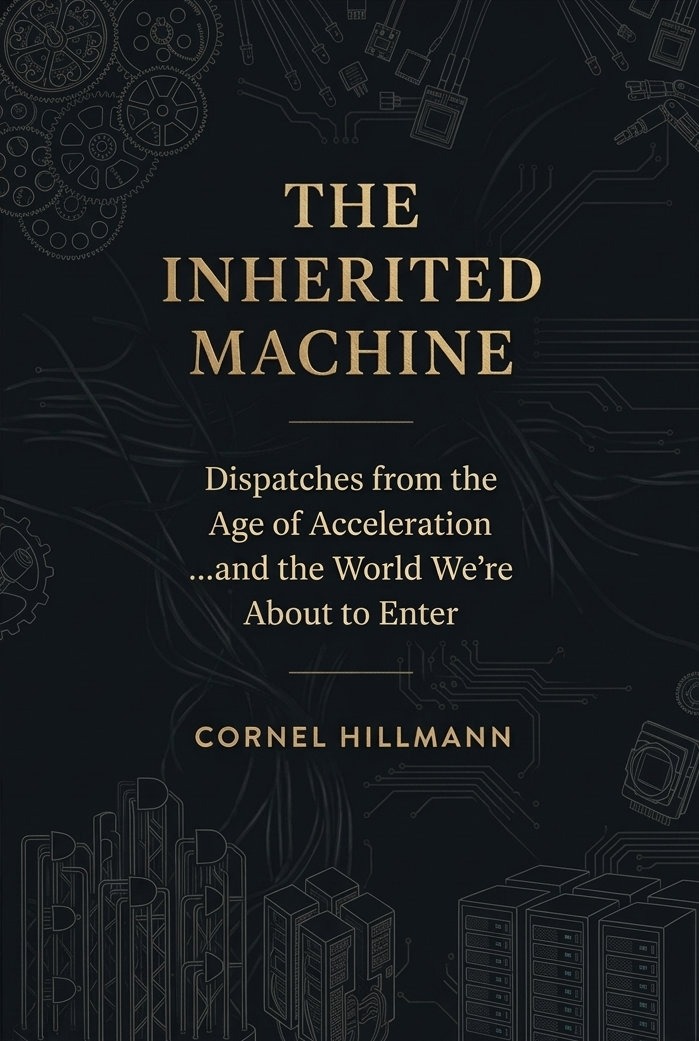
The Inherited Machine
Work in Progress
I’m currently writing a book that moves beyond my previous work in design and technology into something more personal and more systemic.
The Inherited Machine is an attempt to understand the world not as a collection of events, but as a system already in motion when we arrive.
We inherit more than culture or opportunity. We inherit an economic architecture. A set of incentives. A logic that rewards some behaviors, punishes others, and quietly shapes what we believe is possible. For most of my life, I moved through this system without fully seeing it—only sensing its pressure.
This book traces that experience across several decades of acceleration.
It begins in the 1990s, in a moment of techno-optimism—when the internet, gaming, and counterculture promised new forms of freedom. It follows the collapse of that optimism through the early 2000s and the financial crisis, as platform capitalism and social media began to absorb and neutralize the very cultures that once challenged the system.
Along the way, I found myself in unlikely places: working in underground media, engaging with countercultural thinkers, experimenting with early ideas around automation, and later building a career inside the very technological systems that now shape global power.
These experiences were not exceptional. They were intersections—points where personal trajectory and larger economic forces collided. Each one revealed something about how the system works, and where it begins to fail.
Today, as artificial intelligence accelerates the transition toward a post-labour economy, those underlying structures are becoming visible in a new way. The question is no longer whether the system is stable, but whether it can adapt.
The Inherited Machine moves from observation to inquiry:
If the system we live in was designed, can it be redesigned?
This is not a manifesto, and not a memoir in the traditional sense. It is a philosophical and biographical exploration of how we arrived at this moment—and what it might take to build something more balanced, sustainable, and equitable in what comes next.